Marginalist
We are delighted to share this app made by good friend to the Attic Institute, polymath, programmer, digital artist, and novelist Ben Parzybok.
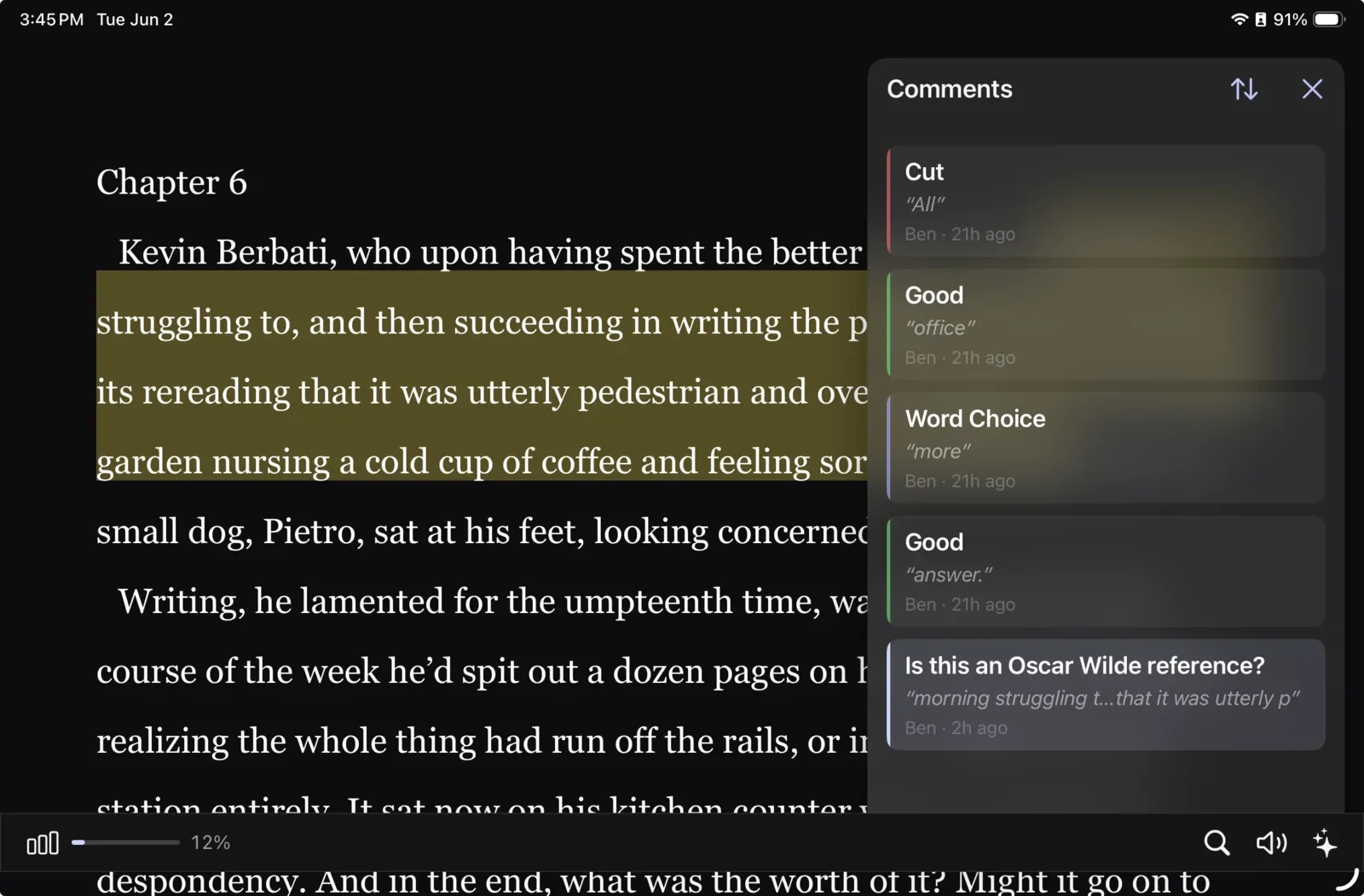
Marginalist is a beautiful reading experience for book editors / agents / publishers, and anyone else making comments on a manuscript. For iOS and iPad.
If you’re a working on long manuscript, here’s the skinny from Ben on why writers need Marginalist.
“Long manuscripts aren't built for phone screens or PDF readers. Marginalist reflows them, remembers exactly where you left off, and gets out of the way. Even better: turn on Read Aloud, plug in your headphones, and take the manuscript walking.”
Below is some great advice for writers from Ben Parzybok himself.
My tools for drafting, reviewing, and submitting writing.
I love to talk to other writers about their tools. Partly it's because no matter your level as a writer, it feels like there's got to be some secret, some new way of channeling a muse or stumbling upon inspiration. Could it be I'm missing just the right tool? There are, quite wonderfully, a thousand ways to pen your work. These tools will help make the tough work easier.
Writing
Scrivener
Scrivener is deep and complex. I know a number of writers who opened it once, aspirationally, and never again. But if you're spending a year or two (or nine) writing your book, the initial work you put in will pay off in spades. Just the ability to separate out your book into chapters and move them around visually is huge. But when you add in research notes, a corkboard for thought organization, writing goals, and a beautiful composition mode, it is worth the time. I draft everything in Scrivener. For comparison, you might try Ulysses, Atticus, or iA Writer.
https://www.literatureandlatte.com/scrivener/overview
Apple Pages
While I'm so-so on Pages as a pure composition tool (that's for Scrivener), it's a great tool for making your manuscript professional, for working with an editor on track changes, and for being part of your writerly workflow. It's free on a Mac, and far less cluttered (and annoying, imo) than either Microsoft Word or Google Docs, and yet it opens the ubiquitous .docx format with aplomb.
https://apps.apple.com/us/app/pages-create-documents/id361309726
What about AI?
First, AI is not a good source of originality. AI is a mishmash of every bit of human culture that their creators have instructed it to consume (I suppose I'm biased, as both of my novels were among the pirated books covered by the the Anthropic settlement). Generating new work is your job. Second, the vast majority of magazines do not want to see any work that has been created, translated, or edited by AI. If I were you, I'd steer clear of it. Your brain, and your potential audience, will appreciate it.
Reading & Review
Marginalist
Full disclosure: This is my app, which I originally built for myself.
I read a lot of manuscripts. For friends, for my writing group, for blurbs, and my own. Paper is the best way to read these, but it's dreadful for sharing manuscript comments.
Enter Marginalist: A beautiful, customizable reading experience on iPad / iPhone (or Mac as an iPad app), with manuscript commenting built-in. Export manuscripts as Word or PDF. Add in text-to-speech to listen to your manuscripts—pause to annotate a section, then continue. It's the app I live in when I'm reading or distraction-free editing a manuscript.
https://marginalist.app
The Attic Institute
As for review and feedback, if you're here in Portland you're already at the right place. Check out The Attic Institute writing workshops https://atticinstitute.com/workshops
Elsewhere, writing workshops and writing groups are fantastic venues for learning the craft and improving your writing.
Submitting
Once you've finished your manuscript, what do you do with it?
Longer pieces:
I'm primarily going to cover my approach to shorter work. The two options for longer pieces (acquiring a literary agent or approaching an independent publisher) are beyond the scope of this article. That said, face-to-face meetings (e.g.: a pitch at a conference), in this age of endless anonymous (and sometimes AI) queries, are huge.
Publishing short fiction or creative non-fiction:
If you've written a shorter piece, or you can excerpt part of your book for submission, here's how I go about submission.
Erika Krouse and Clifford Garstang, both writers, keep excellent 'rankings' of literary journals, based on factors like awards, circulation, payment, etc.
Erika Krouse's List
https://www.erikakrousewriter.com/erika-krouses-ocd-ranking-of-483-literary-magazines-for-short-fiction
Cliff Garstang's list
https://cliffordgarstang.com/2026-literary-magazine-ranking-fiction/
When I approach sending out a short piece, I subjectively judge its strength (sometimes you just know), and begin at that point on the list (Is this really a New Yorker-quality piece? No? Then don't waste your time.) Keep in mind that the top-ranked journals likely accept one in five hundred pieces (or fewer), while journals near the bottom will be far easier to get into.
Once I've picked a few, I then cross-reference them on one of the excellent literary journal data platforms. Both of these platforms allow you to track your submissions and get a feel for when you might expect a response:
Duotrope - a paid service that also offers a literary agent database and community forum
https://duotrope.com
or
The Submission Grinder (free)
https://thegrinder.diabolicalplots.com
What I look for:
do they accept my piece's genre
does my piece fit within their word count limits
do they accept simultaneous submissions
how hard are they to get into
are they open
Lastly, I often look to see if they pay professional or semi-professional rates or just in copies.
When all six are a go, I then visit the journal's site, read their work (if available) and get a feel for them. If that's also a go, submit! You'll get well used to the Submittable platform that many journals use, or Moksha (more favored by genre magazines). For what it's worth, I usually submit a new work to about 5-10 places at a time, and continue to submit as the piece is rejected. If a journal does not take simultaneous submissions, then they should have, in my opinion, quick response times or be the perfect place for your piece.
Is it a laborious process? Yes. But it gets far easier with each round as you develop a feel for the journals. Don't forget that nearly all of them operate with volunteer staff on very low budgets. Consider subscribing to a few! My current favorites are One Story, American Short Fiction, Bourbon Penn, and Strange Horizons.
Benjamin Parzybok has two novels (Couch, Sherwood Nation), and work in journals such as The Bellevue Literary Review, Lightspeed Magazine, West Branch, Apex Magazine, Strange Horizons, Bourbon Penn, and New Orleans Review, among others. Online he's at https://levinofearth.comThe Attic has no affiliate links, sponsorship, or financial ties with Marginalist.